ℹ️ Informational only. This site aggregates public news and does not provide legal or immigration advice. Always verify with USCIS.gov or travel.state.gov. Full disclaimer →
At the end of World War II, great swaths of Europe lay in ruins and millions had been forcibly displaced. This became the 1951 Refugee Convention, which initially applied to Europeans but was subsequently amended in 1967 to apply to all those fleeing persecution. In recent years, some of the world’s richest countries have begun to roll out increasingly punitive policies towards refugees as populist, anti-immigration sentiment has taken hold. Last month the Supreme Court ruled in favour of allowing the Trump administration to turn back asylum seekers at the border and remove temporary protected status (TPS (Temporary Protected Status)) from Haitians and Syrians. This year refugee admissions to the US have been almost exclusively white South Africans . A decade on from the refugee crisis, fuelled by the Syrian war and which saw more than one million people flee to Europe, border guards in several European Union states now routinely conduct violent pushbacks. Greece turns back boats while Poland forces them over the border into Belarus . For campaigners, new European policies fly in the face of the convention’s principles, such as the right to territorial asylum and the principle of non-refoulement. But for proponents of refugee rights, the Refugee Convention has its own limitations anyway. The former Conservative government in the United Kingdom sought to send asylum seekers to Rwanda, until the policy was overturned by the new Labour government in 2024.
From the source
The 1951 UN Refugee Convention marks its 75th anniversary this week but is facing anti-migration sentiment in the West.
Israeli raid deepens fears across West Bank refugee camps Israeli forces expanded their military operations in the occupied West Bank, carrying out a new raid on a refugee camp as journalists reported growing restrictions and violence.
A plan put forward by Britain’s right-wing Reform UK party to deploy the navy to intercept and return asylum seekers arriving by boat has triggered a dispute with France. Reform leader Nigel Farage, who is under political pressure at home over a series of financial scandals and faces a by-election in just more than a week, characterised the mission dubbed “Operation Fortress” not as pushbacks but as “rescue and return”. He argued that, per its humanitarian nature, the measure would not breach international law, as stated by the French Ministry of the Interior. Pointing to the arrival of thousands of migrants in Spain’s North African enclave of Ceuta, Farage on Monday pledged, if elected, to stop a similar “invasion” by launching the largest military operation in the English Channel since World War II. He said the measure would ensure that people are “immediately returned to their point of departure”. Responding to France, Reform said: “We will always stand up for British interests and protect our people, whether [President] Emmanuel Macron likes it or not.” Zia Yusuf, Reform UK’s spokesperson for home affairs, claimed France “sent us 200,000 illegal migrants, including murderers and terrorists”, and that marines would return them anyway to the French coast. Sarah Singer, professor of refugee law at the University of London, described the plan as a “complete waste of military resources”. While returning asylum seekers could be read as an “act of aggression” by France, it would also run counter to international law, said Singer. “Summary expulsions are contrary to UK and European law, which requires those seeking protection to have their cases individually assessed to determine if they can safely be removed,” the lecturer told Al Jazeera. Sarah Wolff, professor in international studies and global politics at Leiden University, noted that while military boats had worked in the past – the Italian Navy mission Mare Nostrum that operated between 2013 and 2014, which had medical facilities on board, was said to have saved tens of thousands of lives and allowed for asylum applications to be processed in Italy – Reform UK’s scheme would instead “return migrants back to France and not take any responsibility for processing asylum applications”, making it equivalent to a pushback. Before exiting the European Union in 2020, the UK had been able to return asylum seekers to the country of first entry under the Dublin Convention, which established the rule of first entry to avoid multiple asylum claims. “Now, it has no means to return them back to an EU country,” Wolff told Al Jazeera. “So it is a bit ironic that (Reform UK, then known as the Brexit Party) which campaigned at the time to ‘gain back control’ is now offering solution to a post-Brexit migration situation it contributed to create.”
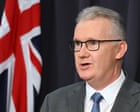
As home affairs minister’s National Press Club address is postponed, refugee advocates lament missed ‘opportunity to bring Australians together’ Follow our Australia news live blog for latest updates Get our breaking news email , free app or daily news podcast Labor will introduce new rules to cut net overseas migration and push temporary residents to leave Australia, despite a major speech on the subject by the home affairs minister, Tony Burke , being delayed. But government sources told Guardian Australia the policy changes would not push net overseas migration lower than the existing target of 295,000 people this financial year. The ABC reported on Wednesday that Burke’s National Press Club address, originally scheduled for this week, had been postponed amid political considerations inside the Albanese government. The rescheduling will allow the prime minister, Anthony Albanese , to help sell any changes as Labor seeks to push back on criticism of its record by One Nation and the Coalition. The rule changes may not reduce net overseas migration (Nom) below the existing target, but could better prioritise parts of the system to tighten working holiday rules and family visa applications, or limit some appeal rights for overseas migrants. Labor’s indicative primary vote ticked up one point to 31% in July, while the Coalition’s share of the vote dropped further, down another point to 22%. Labor has kept the permanent migration target steady at 185,000 people for the 2025-26 financial year, in line with 2024-25, but the rules are getting tougher. International students wanting to undertake postgraduate study will be required to pay $5,750 for a visa, a rise of 25%, and the second in just four months. The energy minister, Chris Bowen, declined to discuss cabinet’s plans on Wednesday. “There’s always a balance to be struck, which is something our political opponents don’t often remember,” he said. “A lot of businesses rely on a very well-calibrated immigration system to provide the workers that, frankly, are difficult for the domestic market to supply.” Asylum Seeker Resource Centre deputy chief executive Jana Favero warned the government against demonising migrants to win back support from Pauline Hanson. “The planned National Press Club address should have been an opportunity to bring Australians together, not to legitimise the politics of fear and division,” she said. “Scapegoating migrants won’t build a home, lower a grocery bill or help a family pay the rent. Australia deserves better than politicians looking for someone to blame instead of delivering real solutions.” Shadow home affairs minister, Jonno Duniam, said Labor had caused “more chaos and confusion” by delaying the speech. “It is clearly only thinking about acting now because the political pressure has become impossible to ignore,” he said.