ℹ️ Informational only. This site aggregates public news and does not provide legal or immigration advice. Always verify with USCIS.gov or travel.state.gov. Full disclaimer →

StatusWire
← Back to feed
Jobs & HiringSep 2, 2026·3 min read

UKG’s CIO says HR tech is AI’s next big bet. The software firm’s employees have already launched 387 AI tools and over 12,000 agents

F

Fortune – Tech

fortune.com
23h ago
UKG’s CIO says HR tech is AI’s next big bet. The software firm’s employees have already launched 387 AI tools and over 12,000 agents

Summary

After a 20-year career at design software company Autodesk , Prakash “PK” Kota felt an urge for a career change, in part because he didn’t want to end his career having worked for only one employer. Upon ending his time at Autodesk with a seven-year stint as chief information officer, Kota made the leap to human resources software company UKG, where he has held the same role since April 2025. He quickly consolidated software vendors, oversaw the launch of 387 internal AI applications from more than 1,400 employee-submitted ideas, and spearheaded the internal creation of more than 12,000 AI agents across Microsoft , Google’s Gemini, and OpenAI’s ChatGPT. “In the AI era, everyone is talking about how work will be reshaped; how do employees and workers coexist?,” says Kota. “HR tech is going to be a huge area of investment in every company.” AI’s ability to automate workplace tasks ranging from coding to customer service to marketing, while increasingly taking on more complex tasks via agentic AI, has put more pressure on businesses and their HR teams to envision a more collaborative workforce that blends humans and machines. There’s also far more demand for prospects who have AI skills at their fingertips: job listings that mention AI are growing almost eight times faster than the total employment market, according to consulting giant PwC. And yet, studies consistently show that the workforce’s youngest cohort, Gen Z, is more worried about their prospects in an AI era than older workers. This is partly driven by the difficulty many are facing in landing their first entry-level job, and swirling headlines of massive job cuts at major employers including Meta Platforms, Verizon , and Oracle , oftentimes with internal AI adoption attributed as a root cause. Even as major employers are overhauling their teams and quickly pivoting on the skills they desire from new recruits, a vast majority of HR leaders say they haven’t yet established a firm grasp on what their internal future workforce needs will be in the AI era. Only 11% of HR professionals reported having established strategic, long-term workforce plans that extend beyond a three-year window, according to a study of about 1,300 HR industry pros across ten countries published by consultancy McKinsey in June. While AI was certainly high on Kota’s agenda when he joined UKG, he said his first major project was addressing the long-delayed IT integration projects that hadn’t yet been completed following the pandemic-era merger between Kronos and Ultimate Software. UKG’s C-suite leadership is also encouraged to think about AI adoption through a so-called “T3” concept: talent, tools, and tokens.

From the source

After a 20-year career at design software company Autodesk , Prakash “PK” Kota felt an urge for a career change, in part because he didn’t want to end his career having worked for only one employer. Upon ending his time at Autodesk with a seven-year stint as chief information officer, Kota made the leap to human resources software company UKG, where he has held the same role since April 2025. He quickly consolidated software vendors, oversaw the launch of 387 internal AI applications from more than 1,400 employee-submitted ideas, and spearheaded the internal creation of more than 12,000 AI agents across Microsoft , Google’s Gemini, and OpenAI’s ChatGPT. “In the AI era, everyone is talking about how work will be reshaped; how do employees and workers coexist?,” says Kota. “HR tech is going to be a huge area of investment in every company.” AI’s ability to automate workplace tasks ranging from coding to customer service to marketing, while increasingly taking on more complex tasks via ag

Read the full article

Published by Fortune – Tech on fortune.com
Open on fortune.com
Advertisement

More in Jobs & Hiring

Crude awakening: The White House’s oil numbers don’t add up
Jobs & Hiring6h ago

Crude awakening: The White House’s oil numbers don’t add up

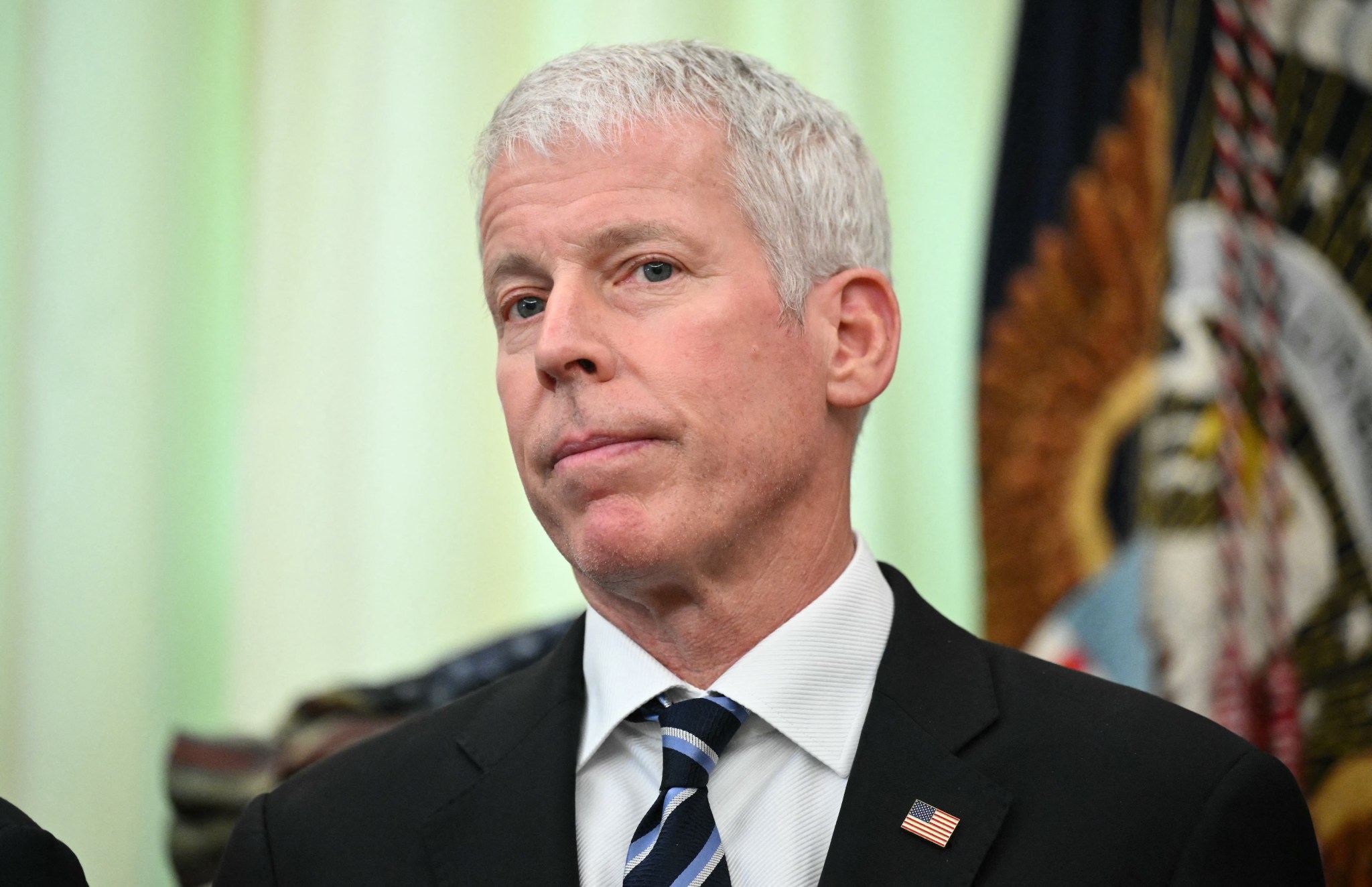
You will be shocked to learn that a politician may have said something misleading. U.S. Energy Secretary Chris Wright raised eyebrows in energy markets Wednesday when he said more oil exports left the Middle East on Monday—between the Strait of Hormuz and alternative routes—than before the beginning of the Iran war. “Monday was our record ever through, since the conflict began. Over 17 million barrels of oil flowed through the Strait of Hormuz on ships on Monday. It appears that Wright is adding up transfers over multiple days into a single day, said Samir Madani, co-founder of TankerTrackers.com, jokingly calling it “mathemagics.” In reality, on Monday, Aug. 31, only an estimated 9.14 million barrels of oil exited the Arabian Sea—including volumes through Hormuz and other routes, Madani told Fortune’s Jordan Blum . (And that explains why oil has stayed above $95 per barrel.) Can We Trust OpenAI to Protect Our Power Grid? | Fortune Daily One of MacKenzie Scott’s latest donations takes her HBCU giving to well over $1 billion - Sydney Lake China demands answers after a man dies hours after entering ICE (immigration enforcement agency) custody—the fifth Chinese national to die in U.S. immigration custody since 2025 - The AP Big tech is investing millions in data centers and saving a quick tax buck while doing it—leaving some states collecting revenue loss - Joshua Hong ‘Critical employees will begin to retire’: Trump’s new pay plan will deny most federal roles a raise, and it has workers warning of a retention crunch - Sasha Rogelberg Toilet paper becomes a kitchen table issue for Trump again as Canada’s retaliatory tariffs could spell another shortage - Catherina Gioino Moody’s head of sustainable finance: Asia is embracing a ‘pragmatic transition’ on energy - Angelica Ang Tim Cook stepped down as Apple CEO, but the ‘Trump whisperer’ isn’t going anywhere - Tatiana Sataua Vanguard’s 401(k) database—of the 2,500 companies that use its services for their 5 million workers—“shows near-zero employment growth in August,” according to Senior Economist Adam Schickling. Retirement plan take-up isn’t an exact proxy for new job creation, of course. But Schickling said in an email that it’s worrying because it occurs at the same time as a large number of workers have simply dropped out of the labor force. If they were still looking for work, the unemployment rate would be much higher than 4.1%, its current level. “The 25-54-year-old labor force participation rate has declined ~50bps [year to date], one of the largest non-recessionary drops in history. This has helped keep the unemployment rate relatively stable despite a cumulative 833,000 decline in household employment since January. Schickling predicts that the dropouts will reverse course in the coming months, “creating upward pressure on the unemployment rate as these workers re-enter the labor force faster than they find jobs.” —Dyson founder James Dyson, upon the launch of his $499 toothbrush that features a camera so you can see inside your mouth as you brush.

Retail’s Recent Performance is Mixed. So is its Outlook.
Jobs & Hiring6h ago

Retail’s Recent Performance is Mixed. So is its Outlook.

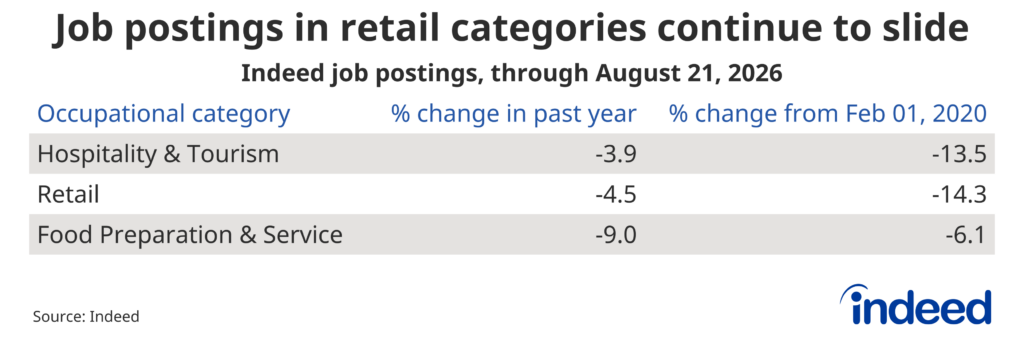
The Retail labor market remains static, with declining job postings, limited hiring, and little movement among workers. The retail labor market remains static, defined by declining job postings, limited hiring, and little movement among workers. The Indeed Job Postings Index sheds light on a retail vertical that is lagging behind the rest of the labor market. Job postings and hiring across retail categories remain muted, but a deeper look into Bureau of Labor Statistics payroll data shows a more nuanced picture. While there are few job postings and little hiring activity in the retail categories, the pay picture is relatively healthy. Low quits rates mean there is less talent available and that talent is more likely to be looking for better roles after leaving their previous job. Recent Hiring Lab research shows that 16% of active job seekers already held multiple jobs while searching for another. The labor market for Retail and related categories remains mixed. Job postings are slowing, hiring rates are flat, and worker quits have only ticked up slightly. Data on wage growth are the average year-on-year percentage changes in wages and salaries advertised in job postings on Indeed, controlling for job titles.

Congo Keeps Struggling to Pay the People Fighting Its Ebola Outbreaks
Jobs & Hiring14h ago

Congo Keeps Struggling to Pay the People Fighting Its Ebola Outbreaks

(Bloomberg) -- Six Ebola checkpoints in northeastern Democratic Republic of Congo stopped reporting last month because the people staffing them hadn’t been paid. Elsewhere, officials checking a list of 240 people supposedly working at an Ebola center could find only 40 of the workers. The discrepancy captures a problem that has dogged Congo’s public health system for decades and is now complicating its fight against the world’s fastest-growing Ebola epidemic. The government is trying to purge fictitious workers from payment lists using biometric registration and centralized payments, after officials found payrolls padded with people who may not actually be working. But verifying those lists is slowing payments to genuine responders, contributing to strikes and disrupting screening, treatment and infection-control work as the disease spreads. “The Ministry of Health doesn’t have an accurate image of who works where and does what,” said Stylianos Moshonas, a University of Antwerp researcher who has studied Congo’s public administration for years. Congo’s difficulties paying its healthcare workforce long predate the current outbreak. Yet among almost 256,000 health workers on personnel lists, fewer than 20% received a base salary, 41% received an occupational-risk allowance and 56% received neither. The workforce has expanded much faster than the government’s ability to pay it, Moshonas said. Formal registration matters even when government salaries are modest because it gives workers greater job security and entitlement to benefits including a pension, Moshonas said. More stories like this are available on bloomberg.com Stay updated with the latest Trending , India , World and US news.