ℹ️ Informational only. This site aggregates public news and does not provide legal or immigration advice. Always verify with USCIS.gov or travel.state.gov. Full disclaimer →

StatusWire
← Back to feed
Jobs & HiringSep 3, 2026·2 min read·🔥 High relevance

Retail’s Recent Performance is Mixed. So is its Outlook.

I

Indeed Hiring Lab

hiringlab.indeed.com
4h ago
Retail’s Recent Performance is Mixed. So is its Outlook.

Summary

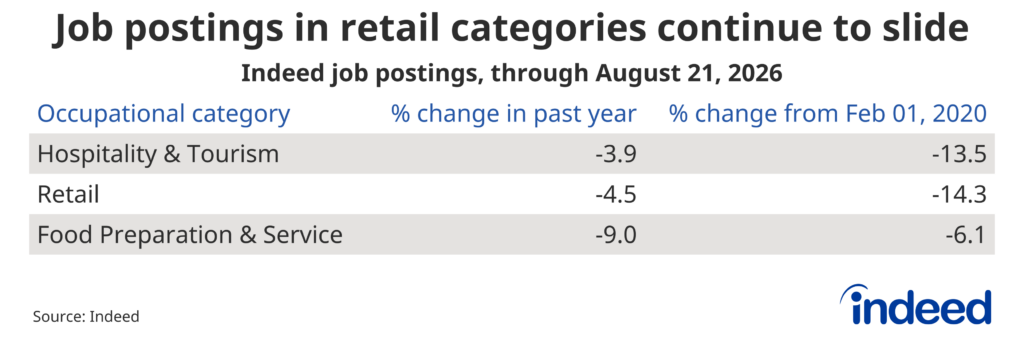
The Retail labor market remains static, with declining job postings, limited hiring, and little movement among workers. The retail labor market remains static, defined by declining job postings, limited hiring, and little movement among workers. The Indeed Job Postings Index sheds light on a retail vertical that is lagging behind the rest of the labor market. Job postings and hiring across retail categories remain muted, but a deeper look into Bureau of Labor Statistics payroll data shows a more nuanced picture. While there are few job postings and little hiring activity in the retail categories, the pay picture is relatively healthy. Low quits rates mean there is less talent available and that talent is more likely to be looking for better roles after leaving their previous job. Recent Hiring Lab research shows that 16% of active job seekers already held multiple jobs while searching for another. The labor market for Retail and related categories remains mixed. Job postings are slowing, hiring rates are flat, and worker quits have only ticked up slightly. Data on wage growth are the average year-on-year percentage changes in wages and salaries advertised in job postings on Indeed, controlling for job titles.

From the source

Key Points: Retail categories are currently not experiencing much hiring activity; job postings and hiring are both below 2019 levels. Wage growth for Food Preparation & Service workers is flat, while wages in retail have picked up slowly since the beginning of 2025. Hiring Lab research shows a substantial share of multiple-job holders work in service sectors, highlighting the need for flexible work arrangements. The retail labor market remains static, defined by declining job postings, limited hiring, and little movement among workers. On top of that, the outlook for retail is uncertain given broad economic volatility and the risk that consumer spending may not hold up forever amid ongoing cost-of-living pressures. In July, the Personal Consumption Expenditures price index – a measure of price inflation – was up 3.7% from a year earlier, well above the Federal Reserve Bank’s stated target of 2%. High inflation is bad enough on its own, but when paired with slowing wage growth, it beco

Read the full article

Published by Indeed Hiring Lab on hiringlab.indeed.com

Open on hiringlab.indeed.com
Advertisement
🗞️ Full Coverage· 2 sources on this story

Assembled automatically from 2 independent reports — every line below is a real sentence from a real source, not generated text. Numbers link to where each point came from.

Data on wage growth are the average year-on-year percentage changes in wages and salaries advertised in job postings on Indeed, controlling for job titles.[1]

The Retail labor market remains static, with declining job postings, limited hiring, and little movement among workers.[2]

Job postings and hiring across retail categories remain muted, but a deeper look into Bureau of Labor Statistics payroll data shows a more nuanced picture.[3]

Year-over-year change (-2.9%) remains negative, but the decline in labor demand is nevertheless decelerating as the labor market continues to hold its course amid several headwinds.[4]

Indeed Hiring Lab(this article)4h ago

Data on wage growth are the average year-on-year percentage changes in wages and salaries advertised in job postings on Indeed, controlling for job titles.

Indeed Hiring LabAug 24, 2026

Overall hiring demand has stayed steady in August, with postings on Indeed increasing marginally over the month and the overall level of job postings bumping along near their pre-pandemic baseline.

More in Jobs & Hiring

Chicago Fed’s Austan Goolsbee wants to get back to ‘old school’ economics: Focused on ordinary Americans, mindful of AI hype, and sharp on inflation
Jobs & Hiring1d ago

Chicago Fed’s Austan Goolsbee wants to get back to ‘old school’ economics: Focused on ordinary Americans, mindful of AI hype, and sharp on inflation

Radical opinions on the economy aren’t hard to come by right now: Tech titans, economists, Wall Street giants, and politicians have all suggested that AI will be transformative, but can’t agree on whether it will be for good or evil. Extreme divides in opinion are also appearing over policy: be it trade, immigration, interest rates, or national debt. The Federal Reserve Bank of Chicago’s President and CEO, Austan Goolsbee, is less concerned with prophecies of chaos or prosperity—he’s more focused on the reality of American consumers, and the businesses they work for. In a landmark Jackson Hole speech last week, new Federal Reserve chairman Kevin Warsh said inflation was the sharpest focus , at present, for the rate-setting Federal Open Market Committee (FOMC), of which Goolsbee is a member. The reason: Price rises are comfortably ahead of the central bank’s mandated 2% target, pushed higher by supply-side shocks like the Middle East oil upset and tariffs. Speaking exclusively to Fortune , Goolsbee agreed with the balance of concerns Warsh laid out: “On the real side, we’ve been stable, now inching toward dangers of overheat, and on the inflation side, after a couple of years of strong progress, it stalled out and started getting worse. But, we’ve had one encouraging report, one OK report, and now our challenge is … the inflation.” The employment side of the Fed’s mandate looks relatively stable across data points such as the unemployment rate, vacancy rate, hiring rate, and the layoff rate, Goolsbee explained: “I think that’s been largely—not the result of AI data centers, for much ballyhoo—it’s the U.S. consumer. Broad-based consumer spending growth is the thing that has kept the economy solid and stable.” And while everyone is closely watching AI’s impact on the labor market—be it layoffs, productivity gains, or demand for certain skills needed for infrastructure—Goolsbee is particularly concerned about potential economic overheating. The 10th president of the Chicago Fed explained he was comfortable with holding the base rate at the last FOMC meeting in July because the most contemporary inflation data had shown some improvement (the all items CPI reading was down 0.4% in June, and a flat 0.1% in July) “so it makes sense to wait and see if this has legs, or is just a blip.” AI has produced some sparkling outlooks for the global economy: Nvidia’s Jensen Huang believes that while there will be some labor disruption, the technology will be a net job creator “at a scale that we have never seen.” Tesla CEO Elon Musk said AI will make money essentially irrelevant and work a hobby , while Meta’s Mark Zuckerberg wrote that AI, in a healthily balanced economy, will see “overall productivity and innovation increase while employment levels remain high.” Meanwhile, Goolsbee is thinking about the “grubby day job” of the Fed, saying the impact of AI on monetary policy depends on how expected the outcomes are. “If the productivity lands on us in an unexpected way, inflation goes down, and rates can go down,” Goolsbee explained. “But the more expected it is, and the bigger the hype … it leads to just old-fashioned overheating in the short run, because equity values go up and so the businesses launch massive capital investment in the here and now, people start spending out of their equity-well in the here and now, before the productivity bounty has arrived.” “It’s fun to engage in the academic exercise of dreaming [about] how AI will affect the long-term growth in the United States or the global economy, and we should think that through, but for the grubby day job of the Federal Open Market Committee, it’s not at all clear.” There’s also the question of when these massive gains come to pass. In a July study, the Fed noted that while sectors with more exposure to AI have higher productivity growth, trends across organizations with low, medium, and high exposure levels remain consistent over time, “suggestive of micro-level productivity gains not adding up in aggregate.” Goolsbee is mindful of this delay and, therefore, wary of applying it too swiftly to the current outlook. “It strikes me it’s a bunch of great technologists who are coming up with this, and they’re wanting to declare themselves economists, and you’ve already seen it not play out the way that they said,” Goolsbee added. “I would like them at least to acknowledge that in the last 10/15 years—this may be the most extreme version—but they have declared numerous technologies were going to totally change the world and displace millions of jobs, and we’re still waiting for those ones to happen, whether from autonomous vehicles to NFTs and blockchain … we’ve had a series of those.” “It’s not to make light, it’s clear that in some sectors the adoption has been so rapid that they’re feeling the pinch, but I don’t believe that the low hiring rate is predominantly caused from AI.” A more unexpected delay between theory and real-world data is emerging in the form of supply shocks.
A new bill would tax AI tokens to fund jobs if the technology causes mass unemployment
Jobs & Hiring1d ago

A new bill would tax AI tokens to fund jobs if the technology causes mass unemployment

If with AI comes unemployment, this group of lawmakers wants AI companies to foot the tax bill. A new House proposal would impose an excise tax on major AI companies and automatically raise the rate if unemployment climbs, funneling the money into creating jobs in areas from housing construction and infrastructure to child and elder care. “If Congress does nothing, the rise of AI could create the biggest wealth transfer in history from the bottom to the top,” said Rep. Sara Jacobs in a joint press release of the bill. “If AI profits off human work, workers deserve job security and a share of those profits. Introduced by Jacobs along with Reps. The bill is the most recent attempt in a concerted effort from Congress to combat potential job displacement as a result of AI. Foushee and Casar previously introduced legislation directing the Government Accountability Office to study jobs created, lost or changed by AI, while Jacobs co-introduced a separate bill requiring large employers and federal agencies to disclose AI-related layoffs to the Department of Labor. In the Senate, Ron Wyden proposed changing the tax treatment of AI data centers and creating a new excise tax, with some of the revenue used to help workers displaced by the technology. Even lawmakers who aren’t proposing taxing AI companies directly are preparing for labor disruption. Jim Banks, Maggie Hassan, John Hickenlooper, and Jon Husted introduced the bipartisan AI Workforce PREPARE Act , which would require better federal tracking of layoffs in which AI is a substantial factor, improve Bureau of Labor Statistics automation-related occupational forecasts, and study a rapid retraining program for workers displaced by AI. Tech leaders worry about AI job displacement The fear of job displacement is shared by the very leaders in the tech space.

July 2026 JOLTS Report: Little Changed. Again.
Jobs & Hiring1d ago

July 2026 JOLTS Report: Little Changed. Again.

Key Points: Job openings were little changed at 7.3 million, according to the Bureau of Labor Statistics (BLS), up from a downwardly revised 7.2 million in June. Year-over-year, Retail Trade saw the largest increase in job openings (+155,000), closely followed by Manufacturing (+152,000). Leisure & Hospitality had the largest drop in job openings year-over-year (-187,000). For those looking for some kind of definitive turning point (in either direction) after months of similar job market dynamics, this report isn’t it. Job openings were little changed at 7.3 million, up from a downwardly revised 7.2 million in June. The hires rate fell to 3.2%, quits ticked down to 1.9%, and layoffs dropped slightly to 1%. The labor market remains low-hire and low-fire, and at this point, it’s starting to look less like a phase and more like the new normal. Year-over-year, Retail Trade saw the largest increase in job openings (+155,000), closely followed by Manufacturing (+152,000). Leisure & Hospitality had the largest drop in job openings year-over-year (-187,000). Indeed Hiring Lab’s Job Postings Index data has already shown the relationship between AI exposure and job openings flip once : AI-exposed occupations led the decline in postings from 2022 to 2026, then led the rebound over the past year.