U.S workers just took home their smallest share of capital since at least 1947—and the lowest ever recorded
Fortune – Tech
fortune.com
Summary
As corporate earnings soar and U.S. GDP balloons, the American workforce isn’t feeling the same boom. American workers are taking home less of the country’s overall income, data from the Bureau of Labor Statistics shows, and employment in the U.S. is set to continue to slow. Goldman Sachs analysts Joseph Briggs and Sarah Dong estimated in a report, based on Department of Labor job numbers, that AI automation could displace 25% of all work hours . An Oxford Economists research brief from earlier this year suggested companies are disguising overhiring-related layoffs as a result of AI, but said automation-related workforce reductions have not yet happened en masse. Mark Regets, senior fellow at National Foundation for American Policy (NFAP), sees a different reason for a slowing workforce. Instead, according to Regets, Trump’s immigration policies have not only decimated the foreign-born workforce, but has also created fewer opportunities for domestic-born workers to find jobs. Recent BLS data is counter-evidence to Miller’s argument that harsher immigration policy would grow the U.S. workforce. Greater immigration can also increase consumer spending and stimulate businesses, as well as encourage businesses to take advantage of ample labor market availability and seek out their labor instead of offshoring jobs. A CareerTrainer survey from June found that 72% of hiring managers intended to reskill employees.
From the source
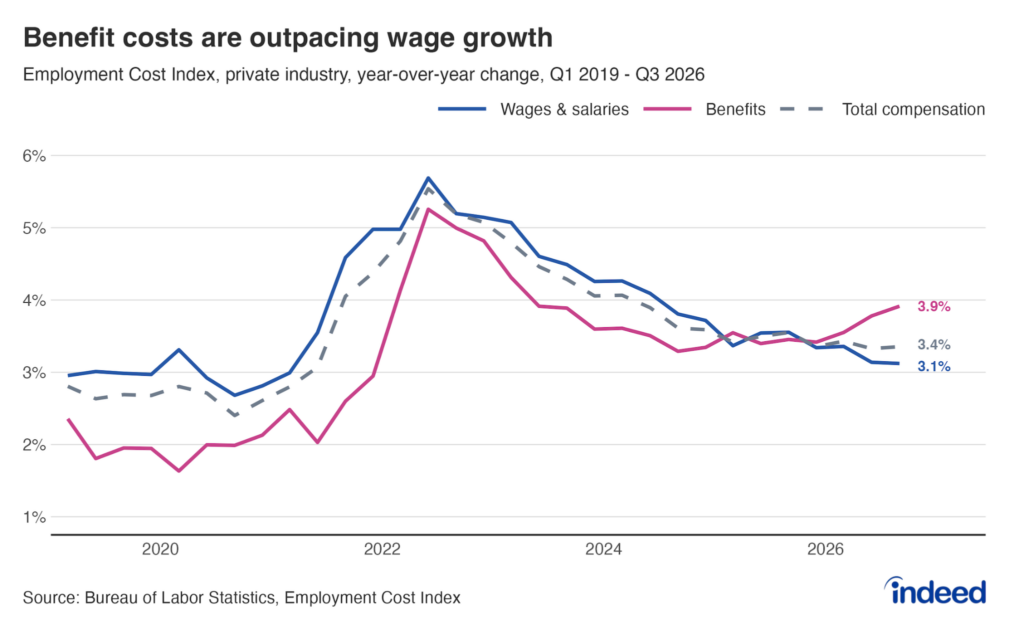
As corporate earnings soar and U.S. GDP balloons, the American workforce isn’t feeling the same boom. American workers are taking home less of the country’s overall income, data from the Bureau of Labor Statistics shows, and employment in the U.S. is set to continue to slow. Labor share, or the portion of the U.S.’s economic output that workers receive through salary and wages, decreased to 52.8% in the second quarter of 2026, its lowest level since the BLS started recording this data in 1947, according to its labor productivity and costs report . In the previous quarter, labor share was at 53.6%. This decade, the labor share average was about 55.6%. That’s despite corporate earnings skyrocketing, with profits for Fortune 500 companies hitting a record $2.1 trillion in 2025. The U.S. GDP grew 3.4% in the third quarter last year, exceeding economists’ predictions. That growth has not only come at the expense of how much of the pie of wealth workers are taking home, but also how many Ame
Read the full article
Published by Fortune – Tech on fortune.com