Q3 2026 Employment Cost Index: Rising Healthcare Costs Keep Haunting Employers
Indeed Hiring Lab
hiringlab.indeed.com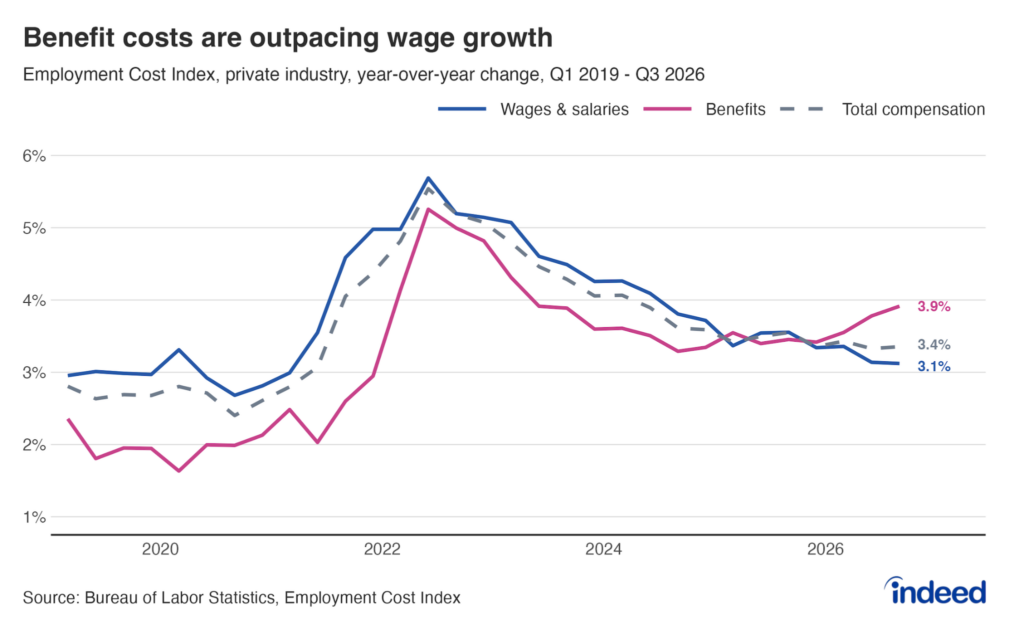
Summary
Key points : Total compensation costs for private-industry workers rose 3.4% year-over-year in the third quarter, according to the Bureau of Labor Statistics (BLS), driven in large part by a 6.4% spike in employers’ health insurance costs. Benefit costs climbed 3.9%, outpacing growth in wages and salaries (3.1%). Adjusted for inflation, real wages fell 0.6% from a year ago, a second straight quarterly decline. Wage growth is falling, but employers’ total compensation costs are rising — a sign that workers are getting paid more on net than they were a few years ago, but taking home less of it in their paychecks as the cost of employer-provided health insurance continues to soar. The tradeoff may be going unnoticed or unappreciated by workers hyper-focused on affordability issues after seeing their real wages decline for the second straight quarter when accounting for high inflation. Total compensation costs for private-industry workers rose 3.4% year-over-year in the third quarter, according to the Bureau of Labor Statistics (BLS), driven in large part by a 6.4% spike in employers’ health insurance costs. Benefit costs climbed 3.9%, outpacing growth in wages and salaries (3.1%). Adjusted for inflation, real wages fell 0.6% from a year ago, a second straight quarterly decline. Employers seem to be noticing the interest in sponsored health plans and are putting health coverage front and center in their job postings as they compete for workers’ attention — especially as wage growth slows and competing solely on pay may be getting more difficult. So far in 2026, 46.9% of US job postings on Indeed mentioned health insurance, up from 45.0% in 2025 and 35.7% in 2022.
From the source
Key points : Total compensation costs for private-industry workers rose 3.4% year-over-year in the third quarter, according to the Bureau of Labor Statistics (BLS), driven in large part by a 6.4% spike in employers’ health insurance costs. Benefit costs climbed 3.9%, outpacing growth in wages and salaries (3.1%). Adjusted for inflation, real wages fell 0.6% from a year ago, a second straight quarterly decline. Wage growth is falling, but employers’ total compensation costs are rising — a sign that workers are getting paid more on net than they were a few years ago, but taking home less of it in their paychecks as the cost of employer-provided health insurance continues to soar. The tradeoff may be going unnoticed or unappreciated by workers hyper-focused on affordability issues after seeing their real wages decline for the second straight quarter when accounting for high inflation. Total compensation costs for private-industry workers rose 3.4% year-over-year in the third quarter, acco
Read the full article
Published by Indeed Hiring Lab on hiringlab.indeed.com